Hiển thị các bài đăng có nhãn UNESCO World Heritage. Hiển thị tất cả bài đăng

Chủ Nhật, 26 tháng 12, 2010

Southern Laos - Coffee, waterfalls and Khmer ruins

Champasak, the southernmost province of Laos, is currently best known for its UNESCO World Heritage site of Wat Phou, a pre-angkorian Khmer ruin complex, situated 10 kilometers outside of Champasak town or around 40 kilometers south of the provincial capital Pakse. Wat Phou is located at the base of mount Phou Kao, some 6 km from the Mekong River.

There was a temple on the site as early as the 5th century, but the surviving structures date from the 11th to 13th centuries. The temple has a unique structure, in which the elements lead to a shrine where a linga was bathed in water from a mountain spring. The site later became a centre of Theravada Buddhist worship, which it remains today.

Another, yet less known temple of Champasak town, is the on the Mekong riverside located temple of Wat Muang Kang. Wat Muang Kang, also known as Wat Phuthawanaram is the oldest temple in Champassak town. Its French colonial and Lao fusion style library (tripitaka) is quite unique architectural example of the colonial past. Wat Muang Kang can be reached by following a small path through lush bamboo, coconut and banana tree vegetation along the riverbanks of the mighty Mekong downstream for about 2 kilometers.

By crossing the Mekong River and cruising downstream, the nearby forest temple Oum Muong also known as Wat Tomo can be reached. Wat Tomo was built in the 13th or 14th century, probably as a rest house for visitors to Wat Phou. Covered by big trees and located on a tributary river to the Mekong, Wat Tomo has a unique charm and atmosphere.

Wat Phou Asa, a ruined Buddhist monastery, is located on the top of a sandstone hill next to Ban Kiet Ngong in the area of Pathoumphone (Phia Fai). Wat Phou Asa was built during the 19th century. The temples unusual shape and layout is probably inspired by Indian models. One hundred eight cylindrical stone piles made of slabs without mortar surround the centrally located sim. Many champa trees have been planted along the walls. The place, isolated in a dry and rocky area, inspires through mystery and wild grandeur. Although its origin is still in the dark, legends say that Wat Phou Asa is the burial place of the jewels, sent by the "Kha" to adorn the palace that Prince Kammatha was building near Wat Phou. When they learned that Prince Kammatha died without finishing the palace, Wat Phou Asa was built as citadel to protect the buried jewels.

The Bolaven plateau, an area well known for its high altitude and therefore all year round cool climate, is best described in two words: coffee and waterfalls.
In the near future coffee will not only contribute to Lao’s economic income as an export product but also as a major tourism attraction. Already today many oversee clients visit the coffee plantations during their stay in Pakse or on the Bolaven Plateau.
Mr. Sinouk Sisombat, the president of the Lao Coffee Association is currently building a resort on a 50 hectare coffee farm near Pakxong, about 80 km outside of Pakse. He plans to offer an agro-coffee tourism package, where clients staying at the resort can pick and process their own coffee beans during their stay…

Champasak is already today one of the top tourist destinations in Laos, with an annual tourism growth of around 10% over the last five years. In absolute figures around 300’000 people visited the province during 2009 and 2010. Most of these people visited Wat Phou, the Sipandone area and the province many waterfalls.
Coffee tourism is a new idea for Champasak province and could and would be a welcomed addition to any tour program in the area. Khiri Travel Laos offers already today some interesting tours and programs in the province and on the Bolaven plateau…

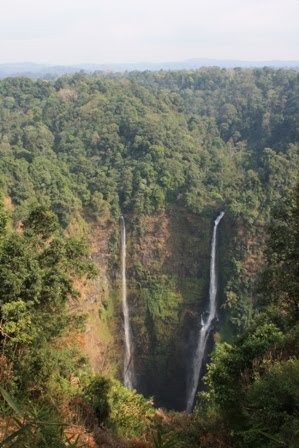
The Bolaven plateau offers also some very nice accommodation: Tad Fane Resort, which is hidden amidst the dense rainforest and overlooking the foaming twin waterfalls. The water of Tad Fane plunges 200 meters down a gorge which is really an amazing sight. Other nearby waterfalls such as Tad Yeuang, Tad Champee and Tad E Tu can be discovered during a day tour or on own along with coffee and tea plantations.


More reading information can be found here:
A tour program can be found here:
Continue Reading →

Thứ Bảy, 29 tháng 5, 2010

Kuang Si waterfall, Luang Prabang's highlights

The Kuang Si water fall is about 30 kilometers south of the UNESCO World Heritage town of Luang Prabang, Laos. The falls and the nearby bear sanctuary is a favorite trip for tourists while in Luang Prabang. The Kuang Si water fall begins in a pool atop a hillside. This pool leads to the main fall with its 50 meter cascade. Further down numerous turquoise blue pools collect the water on its way downstream.


Continue Reading →

Thứ Hai, 19 tháng 4, 2010

Lush river life... some impressions...

Ferry crossing the Mekong River in Ban Houay Xay, Bokeo Province, Northern Laos.
Boys playing football on the banks of the Nam Ou in Ban Soph Van, Luang Prabang Province, Northern Laos.
Ban Nong Khiow at the Nam Ou, Luang Prabang Province, Northern Laos.
Fisherman checking his net on Nam Khan, near Luang Prabang, Luang Prabang Province, Northern Laos.
Training for the boat racing festival?, Nam Khan, Luang Prabang Province, Northern Laos.
Children enjoying the 2008 flood at Nam Khan Riverside, Luang Prabang town, Laos.
Girl watching the 2008 flooding in Luang Prabang town, Luang Prabang Province, Northern Laos.
Boats in Luang Prabang, Laos.
Boat racing festivals are held in Cambodia, Laos and Thailand during the months of September and October.
Flooting restaurant in Pakse on the Sedone River, Champasak Province, Southern Laos.
Boat landing to cross the Mekong river, opposite Ban Champasak (near UNESCO World Heritage site of Vat Phou), Champasak Province, Southern Laos.
Sunset over the Mekong, Khong Island, Sipandone area, Champasak Province, Southern Laos.
Abundant fish life, market on Khong Island, Champasak Province, Southern Laos.
Fisherman fixing his traps, Preah Rumkel community, Stung Treng Province, Cambodia.
Ferry boat in Stung Treng town, Stung Treng Province, Cambodia.
Continue Reading →

Thứ Bảy, 2 tháng 1, 2010

Laos' Plain of Jars - the next UNESCO World Heritage site

The Lao government prepares the nomination dossier to inscribe the Plain of Jars to become the third Lao UNESCO World Heritage site, after the ancient town of Luang Prabang in the north of Laos and the ruined Khmer temple of Vat Phou (Champasak province) in Laos' South. The Plain of Jars is situated on a vast plateau in the Vietnam bordering province of Xieng Khouang. A province, which was often conquered and fought for in the past because of its strategic importance to the Vietnamese Emperors residing in Hue as well as to the Kings of the Lao Kingdom of Lane Xang.

The jars can be found all over the plateau, scattered in clusters of up to 300 at different spots, and varying in size from one to over three meters in height. However, the most famous jar sites are located in close proximity to the town of Phonsavanh, the provincial capital of Xieng Khouang province.

Some locals belief, that the jars were build as big distilleries for alcoholic drinks, brewed to celebrate various victories and military campaigns won in the past over ancient enemies. More scientific and archaeological evidence suggests that the jars are used as urns for funerary. They were used by people back in the Bronze Age approximately 2'000 years ago.

In the Second Indochina War, Xieng Khouang once again, played an important role as battle ground in the fights between Pathet Lao revolutionary troops and the Royal Lao government and its American backed Hmong rebels. Many battles and intense aerial bombardments took place. Its legacy, the contamination of the land with unexploded mines and bombs, still takes its toll today amongst the rural villages and farmers.

However, nowadays Xieng Khouang province in central Laos is a peaceful area with a cooler weather then elsewhere in Laos, vast grasslands, ethnic minorities and a developing tourism industry with good hotels and interesting attractions.

The Plain of Jars can be reached either from the Lao side by air from Vientiane or by following the National highway 7 from Phou Khoun or from Vietnam. The Lao government is constructing the National highway 10 from Phonsavan to Pakxan, which will link the province even closer with Vientiane and the Southern Lao provinces.
Continue Reading →

Thứ Ba, 15 tháng 9, 2009

Luang Prabang in Laos

Luang PrabangThe Ancient town of Luang Prabang, which lies in the center of Laos, has been described as one of the most beautiful and preserved towns in Southeast Asia. In 1512 King Visounarat got Buddha image - the Pha Bang - as a gift from the Khmer monarchy, that is where the town became known as Luang (Great or Royal) Phabang (Prabang). Luang Prabang was the capital of Lane Xang (Laos) for many years until King Phothisarat moved the royal seat to Vientiane in 1545.

There are 34 Buddhist temples among colonial French and Chinese architecture, all nicely located within surrounding green mountains.

The Mekong River, which frames the western border of the town, is still used as transportation link within Vientiane, the capital of Laos, and other important cities along the Mekong River.
Temple Its cultural traditions, rituals and artwork, which includes temple murals, woodcarving and pottery, make Luang Prabang an attractive cultural tourism destination and an ecotourism hub for the whole region, which allows visitors to do hiking, tracking, elephant trekking, kayaking and other adventurous activities in a spectacular natural environment with possibilities which cope for a wide range of interests. The town of Luang Prabang was listed as a UNESCO World Heritage site in 1995 due to its cultural and natural features. Luang Prabang is accessible by air directly from Bangkok, Vientiane and Chiang Mai, but also overland travel is an option from all directions. There is also a regular boat service on the Mekong River available.

Most of the visitors to Luang Prabang enjoy its cultural and historical heritage, stay in nice renovated Old townguesthouses and small lodges for 20 to 30$ per night. However, there are also quite a few backpackers with an interest in Luang Prabang’s culture as well, but the will also enjoy some more adventurous excursions and day trips to the countryside of the ancient town. Laos is strongly promoted as an ecotourism destination in Asia, whit a lot of interesting national and international ecotourism projects and developments going on. A quick search in Google for “ecotourism” brought up a 150’000 hits and 108’000 hits for “sustainable tourism”.
The amount of visitors tripled within the last 10 years from around 400’000 in 1996 to about 1, 3 Mio in 2006 according to the Lao National Tourism Administration. About 1 Mio of the customers are Asians, where the visitor numbers from Thailand (600’000) is the biggest, followed by Vietnam (170’000) and China with 50’000 old lady in luang prabangvisitors in a year. China has now allowed its citizens to travel more freely to Laos. Therefore, Chinese tourists numbers to Laos are expected to rise and will probably account for 25% of the total number of visitors to Laos in the future. Europeans or Westerners account for about 200’000 tourists.

The pressures on Laos to modernize and develop its tourist infrastructure is rapidly increasing, there is a big demand to cater for an increasing amount of package tourism, which will have a significant impact on the development of Luang Prabang.

Therefore, the inscription of Luang Prabang on the World Heritage List in 1995 happened just at the right time, to preserve the town of Luang Prabang. With new roads being build from Vientiane and the Chinese border, the small town of Luang Prabang was about to rapidly expand and transform it - not an entirely positive development.
monk There is now a strict zoning law, which ensures that the character of the town is preserved by restricting advertising billboards and decreeing that no out-of-character buildings can be constructed, which means, that no photo-finishing shops or fast-food outlets can be opened in the old town. Big tourist buses are not allowed within the old quarter of the town. Luang Prabang promotes eco-friendly tourism in different ways, such as reinforcing the visitors to walk or ride a bicycle to explore Luang Prabang, closing roads to make space for the morning and night markets, and setting and enforcing speed limits within the whole town (quite unique in Asia).

There are very good maps available, which make it a pleasure to walk around to visit the different attractions of the towns. All attractions are also well explained in Laotian, French and English language. There are many good web sites and books, with a lot of useful information on Luang Prabang available, so that the visitors can inform themselves easily. In the town are also some very good local tour guides available, so the cultural interested tourists can get there information from locals as well.

Market In the UNESCO plan, there are three zones: the old quarter, a peripheral zone, and natural zones along the Mekong River. The main problem is now how to maintain Luang Prabang as a World Heritage Site and accommodate the fast growing number of tourists that will be attracted.

The Luang Prabang authorities are handling increased tourism well so far. The plan is not to build new hotels, but rather modify existing mansions for use as hotels. The whole area has a lot of natural attractions within a short distance, such as caves, waterfalls, jungle and rivers and the plan of the Laos authorities is, to further develop sustainable tourism by involving local communities in the over all tourism development of the area, but also to direct some of the tourist to the neighboring attractions to take some pressure of Luang Prabang.
My recommendation is, to raise some of the entrance fees of the attractions for foreign visitors, which may take a little bit pressure of the attractions by reducing the amount of visitors to them. With the so collected money the local authorities would have the choice to renovate some public buildings, such as schools and government buildings, which will further improve the image of the town. Then, there are a few hotel developments well underway about 5 to 10 km outside of the town. I suggest providing some shuttle bus or other public transport to accommodate for the visitors need to go out to town, to prevent them of using private taxis and motorbikes. Then, I think, that the roads of the old quarter should and could be closed during the day time for private traffic to implement a pedestrian zone.

Laos has done a lot to improve its tourism facilities and to make it easier to obtain Visas for tourists, therefore tourism will further grow. Especially, when the fast growing and powerful neighbor China starts to travel, I think, tourism in Laos and basically in the whole region will change dramatically.
Continue Reading →

Popular Posts