Hiển thị các bài đăng có nhãn Bolaven Plateau. Hiển thị tất cả bài đăng

Thứ Ba, 17 tháng 5, 2011

Zip Through the Tree Tops in Laos

Khiri Travel Laos is offering two- and three-day tours to join Tree Top Explorer in Paksong, southern Laos. This is your chance to sleep in the Jungle Hotel 10 meters above the ground in a tree house. During the day, ride the zip line for an adrenalin rush. ‘Fly’ over deep ravines almost within touching distance of the roaring water and the green roof of the trees.

Guests can also trek in pristine forest and through coffee plantations. Discover the hidden world of the forest canopy from a sky-high walkway. Experience the jaw dropping – but safe – via ferrata (cliff walkway with support cables).

All this takes place in the Dong Hua Sao mountain range, one of 20 National Protected Areas in Laos. The park spans over 1,100 sq km, half of it truly mountainous with steep to very steep slopes rising to the edge of the Bolaven Plateau at an elevation of around 1,000m. Some peaks near the plateau rim rise up to almost 1,300m. The other half of the park is lowland with rolling hills and elevations from 100 to 300m.

To get a feel for the ‘deep forest’ experience that Khiri Travel Laos can arrange for your clients, visit www.treetoplaos.com.
Continue Reading →

Thứ Sáu, 8 tháng 4, 2011

High on Coffee in Southern Laos

March 15, 2011 By Khiri News

We would like to give you a high quality caffeine rush. Paksong, 50 kms from Pakse in southern Laos, is the coffee growing capital of the country. Khiri Travel Laos now offers a Mr. Coffee tour up to the Bolaven Plateau at a nice and cool 1,300 metres to inspect the coffee growing region. There are around 5,000 families involved in growing coffee on the plateau.

The tour is highly informative, especially in the coffee nursery. The tour explains about the physical suitability of the plateau and how farmers have to adapt to international demand trends. The coffee story is explained from a Laotian and Western perspective. After learning, comes sampling. All visitors can roast some fresh coffee and enjoy their own freshly wok-roasted Arabica or Robusta coffees.

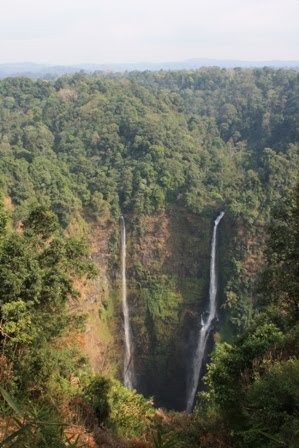
On the way back, the Mr. Coffee tour visits Tad Yeuang (‘Wild Goat’ waterfall), one of the most spectacular in Laos. We try some local cuisine and visit a village school in Tad Fane.

Knowledge, views, taste and helping local children – all part of Khiri Travel Laos’ Mr Coffee tour. More information: www.paksong.info
Continue Reading →

Chủ Nhật, 26 tháng 12, 2010

Day tours in Southern Laos...

Relaxed Siphandone by boat Khong Island
Full day tour, Meals provided: L (picnic), Tour Code: KLP‐PKZ‐001


Starting from Khong Island at 8.30am, you explore the Siphandone area with your guide on a boat cruise to Khone Island.

Along the way observe locals engaged in fishing, bathing, swimming or farming activities.
On Khone Island visit the remains of a French locomotive. Take then a bicycle and ride to the spectacular Somphamit Falls.

Cycle back to Muang Khone, and enjoy lunch at Seng Ahroun restaurant.

After lunch, ride to the southernmost tip of Khone Island, where you observe the old French port, and follow the eastern shore, where concrete embankments used to channel logged trees.

Cross over the bridge and experience Det Island, the small island to the North of Khone Island. Det Island is a back backer’s paradise. Follow the road to the other end of the railway, where another pier awaits you.

Late this afternoon you return to Khong Island at 4.30pm.

Discover the Bolaven Plateau: Waterfalls, Gorges,Coffee fields and minorities
Full day tour, Meals provided: L, Tour Code: KLP‐PKZ‐002

You will be met at your hotel around 8.30am for a full day tour of the Bolaven Plateau.
Start your tour by driving up to Paksong, on the way you’ll visit coffee fields, Tad Fane waterfalls and Tad Yeuang ('Wild Goat') waterfall, one of the most spectacular waterfalls in Laos. You make a stop at the local Paksong Market.

Your Lao lunch is served at Ban Ta Thang nearby the market or at Tad Lo Waterfall.

After a short rest, you'll drive to Ban Kok Phoung to meet the Katou, one of the indigenous Mon‐Khmer ethnic groups in this area. Khmu, Alat, Ngae, Kalung, Lavane, Lavere, Katung ethnic groups you can be observed here, too.

You'll then continue your visit to Ban Houay Houn, a traditional weaving village. From here drive to Tad Phasuam and visit a small nearby ethnic cultural park.
Return to your hotel at 4.30pm.

Explore Wat Phou, Wat Muang Kang and Wat Tomo
Full day tour, Meals provided: L, Tour Code: KLP‐PKZ‐003

Meet at 8am at your hotel; and visit Pakse’ fresh market, where your guide explains you local products. Then drive to Champassak. On the way you visit Wat Phou Ngoy.

Visit Wat Phou. This Khmer temple Wat Phou was declared a World Heritage Site by UNESCO in 2002. The walk to the upper part of the temple is steep, but the view over the surrounding countryside is rewarding.

You have a simple lunch 'fer' at the local noodle soup shop.

After lunch continue by boat to a nearby temple, Vat Muang Kang. Vat Muang Kang is the oldest temple in Champassak. Its French‐Lao fusion style library (tripitaka) is a unique architectural example of the colonial past.

Continue to visit Um Muang by boat. Um Muang (aka Wat Tomo) is a small Khmer temple ruin in the forest.

Return by car back to Pakse at 4.30pm.
Continue Reading →

Southern Laos - Coffee, waterfalls and Khmer ruins

Champasak, the southernmost province of Laos, is currently best known for its UNESCO World Heritage site of Wat Phou, a pre-angkorian Khmer ruin complex, situated 10 kilometers outside of Champasak town or around 40 kilometers south of the provincial capital Pakse. Wat Phou is located at the base of mount Phou Kao, some 6 km from the Mekong River.

There was a temple on the site as early as the 5th century, but the surviving structures date from the 11th to 13th centuries. The temple has a unique structure, in which the elements lead to a shrine where a linga was bathed in water from a mountain spring. The site later became a centre of Theravada Buddhist worship, which it remains today.

Another, yet less known temple of Champasak town, is the on the Mekong riverside located temple of Wat Muang Kang. Wat Muang Kang, also known as Wat Phuthawanaram is the oldest temple in Champassak town. Its French colonial and Lao fusion style library (tripitaka) is quite unique architectural example of the colonial past. Wat Muang Kang can be reached by following a small path through lush bamboo, coconut and banana tree vegetation along the riverbanks of the mighty Mekong downstream for about 2 kilometers.

By crossing the Mekong River and cruising downstream, the nearby forest temple Oum Muong also known as Wat Tomo can be reached. Wat Tomo was built in the 13th or 14th century, probably as a rest house for visitors to Wat Phou. Covered by big trees and located on a tributary river to the Mekong, Wat Tomo has a unique charm and atmosphere.

Wat Phou Asa, a ruined Buddhist monastery, is located on the top of a sandstone hill next to Ban Kiet Ngong in the area of Pathoumphone (Phia Fai). Wat Phou Asa was built during the 19th century. The temples unusual shape and layout is probably inspired by Indian models. One hundred eight cylindrical stone piles made of slabs without mortar surround the centrally located sim. Many champa trees have been planted along the walls. The place, isolated in a dry and rocky area, inspires through mystery and wild grandeur. Although its origin is still in the dark, legends say that Wat Phou Asa is the burial place of the jewels, sent by the "Kha" to adorn the palace that Prince Kammatha was building near Wat Phou. When they learned that Prince Kammatha died without finishing the palace, Wat Phou Asa was built as citadel to protect the buried jewels.

The Bolaven plateau, an area well known for its high altitude and therefore all year round cool climate, is best described in two words: coffee and waterfalls.
In the near future coffee will not only contribute to Lao’s economic income as an export product but also as a major tourism attraction. Already today many oversee clients visit the coffee plantations during their stay in Pakse or on the Bolaven Plateau.
Mr. Sinouk Sisombat, the president of the Lao Coffee Association is currently building a resort on a 50 hectare coffee farm near Pakxong, about 80 km outside of Pakse. He plans to offer an agro-coffee tourism package, where clients staying at the resort can pick and process their own coffee beans during their stay…

Champasak is already today one of the top tourist destinations in Laos, with an annual tourism growth of around 10% over the last five years. In absolute figures around 300’000 people visited the province during 2009 and 2010. Most of these people visited Wat Phou, the Sipandone area and the province many waterfalls.
Coffee tourism is a new idea for Champasak province and could and would be a welcomed addition to any tour program in the area. Khiri Travel Laos offers already today some interesting tours and programs in the province and on the Bolaven plateau…

The Bolaven plateau offers also some very nice accommodation: Tad Fane Resort, which is hidden amidst the dense rainforest and overlooking the foaming twin waterfalls. The water of Tad Fane plunges 200 meters down a gorge which is really an amazing sight. Other nearby waterfalls such as Tad Yeuang, Tad Champee and Tad E Tu can be discovered during a day tour or on own along with coffee and tea plantations.


More reading information can be found here:
A tour program can be found here:
Continue Reading →

Thứ Ba, 22 tháng 6, 2010

Waterfalls on the Bolaven Plateau

The Bolaven Plateau is an elevated region in Southern Laos Champassak province. The elevation ranges from about 1'000 to 1'350 meters above sea level.

The plateau is a reach cultural and agricultural area, crossed by several rivers and scenic waterfalls.

The name of the plateau 'Bolaven' refers to one of its ethnic group which have dominated the region: the Laven. However, migrations by the majority Lao ethnic group has modified the ethnic composition of the region. Other ethnic groups in the Bolaven Plateau are the Alak, Katu, Ta Oy, and Suay.

Nowadays the Bolaven plateau is an important agricultural area which produces one of the best coffee in the world. Another important factor is tourism, which greatly contributes to the regions growth. Lastly, bauxite mining is increasingly becoming more important as well.

Tad E Tu Waterfall

Tad E Tu Waterfall is located between Pakse and Paksong at KM 35. The waterfall can be reached over a small and steam path and stairs. The small pool at its bottom invites with some refreshing swimming opportunities.

Tad Champee Waterfall

Tad Champee Waterfall is located between Pakse and Paksong at KM 38, opposite Tad Fane waterfall. The waterfall is about 3 kilometers from the main road. The Tad Champee consists of one single cascade. Its pool is offering some refreshing bath...


The Tad Fane Waterfall

The Tad Fane Waterfall is 38 KM outside of Pakse and probably the biggest twin waterfall in the Bolaven region. The water dropps over 100 meters!. The best view on this waterfall one gets from the nearby view point at Tad Fane Resort, a friendly lodge overlooking the gorge of the Tad Fane waterfall and nestled within some tense vegetation. For a closer look a small walk of 15 minutes is required to reach the bottom of the falls.

Tad Yuang Waterfall

Tad Yuang Waterfall is a bit further along the way to Paksong at KM 39. This waterfalls comes with a nice pick nick area at the top of the waterfall. A view point at the top allows a great panorama over the whole waterfall.


Tad Phasuam Waterfall

Tad Phasuam Waterfall is on the way to Tad Lo in Salavan province, after leaving Pakse turn left at KM 21 and continue for a further 15km. Tad Phasuam Waterfall is a beautiful cascade in a U form. There is a small cultural village nearby.
Continue Reading →

Thứ Sáu, 14 tháng 8, 2009

Lao Mountain Coffee in Vientiane

During my last stay in Vientiane I read an interesting article about Lao Mountain coffee and the Jhai Coffee Farmers Cooperative in Stay another day.

Lao Mountain Coffee (www.laomountaincoffee.com) is a Vientiane based coffee roasting company. They roast some specialty grade coffee from Laos famous coffee growing area in the South, the Bolaven Plateau.

In fact they are the only Fair Trade and organic coffee roasting company in Laos and one of only a few in South East Asia. They have developed a close relationship with the Fair Trade certified farmer group, the Jhai Coffee Farmers Cooperative (www.jhaicafe.com), which resides in Champasak province. The Cooperative runs a tiny little office in Pakse town. Day trips can be arranged to visit the small farms around Pakse town.

Steve Feldschneider (info@laomountain.com), the owner, invited me to visit Lao Mountain coffee, which is located in Ban Nongbone in Vientiane capital and only 200 meters away from the That Luang Stupa.

Upon my arrival at the Lao style Villa a nice breeze of freshly roasted and grounded coffee leaded me directly to the heart of the Lao Mountain Coffee company.

Steve welcomed me and gave me a brief overview of Laos coffee producing history. He also explained me about the roasting process and their special way to produce small amounts of coffee on order. Using small amounts of coffee at a time gives them the possibility to control the grade of roasting and the mixture of different coffee beans to a much better extend than in an ordinary coffee roasting company.

The fact that he has such well known names amongst his clients as Residence Phou Vao, Maison Souvannaphoum in Luang Prabang or the world famous Oriental hotel in Bangkok proves his roasting philosophy true.

Towards the end of my visit Steve told me about the cupping process. Cupping is the art of coffee tasting. Coffee consists of more than 800 different aromatic compounds, so coffee cupping is one of the most complex sensory experiences one can do.

Coffee beans from different growing areas, unwashed and washed, roasted and grounded are provided along with a professional instruction about coffee cupping.

Of course , there are also some cafe tables in the lush garden around the Villa, where a freshly roasted and grounded coffee can be tasted after a visit in the nearby That Luang Stupa.

The coffee cupping experience can be arranged for visitor upon prior notice. The program consists of the coffee cupping experience, the tour through the Villa’s compound, including the roasting and manufacturing areas of the company. Visitor can also get some hands on roasting and grounding experience.

Although the price of the coffee cupping program is a bit high - there is lots of fresh coffee and unique experiences involved, which one hardly can get elsewhere and for less money.

Needless to say that once Steve found out that I have a favour for Italian style coffee he offered me a special blend, which he prepared by himself. Well… Another story from Laos…
Continue Reading →

Popular Posts